We have moved!

This blog is no longer actively updated. You can now find us at http://poetscollective.org/poetryforms/.

Friday, December 13, 2013

Yabba Dabba Do

The YABBA DABBA DO was created by Havyk Dementius of Allpoetry
         
It is syllabic 5/10/10/10/10  15/10/10/10/10  15/15
It is a complete poem consisting of two quintets and rhyming couplet.

Line 1 consists of 5 syllables.                                         
Lines 2-5 follow an ABBA rhyme scheme in iambic pentameter. 
Lines 6 & 11 &12  consist of 15 syllables.                         
Lines 7-10 follow an ABBA rhyme scheme in iambic pentameter.  
Lines 11 and 12 must rhyme.                                                                        

Thus the Rhyming pattern is xabba xabba cc

Example Poem

Cluttered Nest     (Yabba Dabba Do)

I'm motivated
yet have so many things I have to do
I have no notion where I  ought to start.
Sometimes I wish that I had had a clue-
I should have started with another part.

You left to visit relatives living several states a way.
I've cleaned out what was called garage- in fact
the cars can now be driven right inside.
A double storage shed I've built out back
for all the detritus we must abide.

Since we're storing the kids stuff 'til they decide to move away
out of site it's hiding now; our kids and stuff will always stay.

© Lawrencealot - December 13, 2013


Visual Template


Thursday, December 12, 2013

Strambotto

The Strambotto has three primary versions:
All are presented here.
The Siciliano,  rhymed abababab
The Tuscano,  rhymed ababccdd (preferred), abababcc,  aabbccdd
and the Romagnuolo, rhymed ababccdd

It is:
Lyrical - Written as one octave, or with the Tuscano, possibly one sestet.  It you wish to write several stanza it becomes an Ottava Rima.

Rhymed - Each with its specific pattern(s).

Isosyllabic - Each line has precisely eleven syllables.

Below are additional resources with history and added information.  At the end you will find my Visual Templates.
________________________________


Strambotto


This was an early form of Italian poetry that was set to music by composers of the frottola and madrigals of the 16th century. The poetry is set into very strict stanzas of eight lines of eleven syllables. This type of stanza is known as rispetto or ottava rima. The musical rispetto was usualy dedicated to a lady love, Aside from the fact the ottava rima had no set form length and later became Iambic it also came from literature and generally had multiple stanzas, but musical version, the strambotto was typically created with a single stanza.
There are three basic types of strambotto and they are identified by their rhyme scheme.


1. Strambotto Siciliano
It will be noted that this is similar to the Sicilian Octave, but follows the Strombotto rules and consists of eight strict hendecasyllable lines (11 syllables), and similarly for multi stanzas.

a. b. a. b. a. b. a. b. 


2. Strambotto Toscano
This form is most used for stand alone poetry, but can be used for multiple stanzas. When writing muliple stanzas (as in a song), it is usual to link each stanza by either a refrain or using the whole or part of the last line of the previous stanza as the first line of the next stanza:

a. b. a. b. a. b. c. c. 


3. Strambotto Romagnuolo
This form has the octave constructed from a Sicilian quatrain and a quatrain of two couplets. The same rules apply about stand alone poems, and multiple stanzas.

a. b. a. b. c. c. d. d


My thanks to the poetsgarret.


The Strambotto is thought to have influenced the development of the Sicilian Octave and the birth of the sonnet. The Strambotto is one of the earliest Italian verse forms and can be found in works from the 12th through the 19th centuries usually set to music. The name comes from the Occitan,estrabot which refers to sentimental and or amorous rhymes. Sources suggest the early Strambotto varied between 6 or 8 lines long however it was eventually recognized as an 8 line form holding fast to a strict 11 syllable line. Rhyme seems to be delineated by territory, Tuscan, Sicilian and Romano. The frame appears to be the same as the Ottavo Rima Stanza. However, the forms are quite different in that the Strombotto is limited to a single lyrical, octave while the Ottavo Rima is a narrative, stanzaic verse written with any number of octaves. 
 IN ADDITION THE OTTAVO RIMA may be decasyllabic LARRY
The Strambotto is:
  • lyrical.
  • an octastich, a poem in 8 lines. (When written in narrative stanzas it is better known as Ottava Rima)
  • syllabic, strict hendecasyllabic lines. In English it has been found in iambic pentameter.
  • rhymed, most often follows the Tuscan patterns of abababcc and occasionally aabbccdd and is sometimes called Strambotto Tuscano. TheSicilian Strambottos followed the rhyme pattern of abababab and the Strambotto Romagnuolo carries a rhyme scheme of ababccdd.


My thanks to PoetryMagnumOpus

Strambotto (Sicilian)
Type:
Structure, Metrical Requirement, Rhyme Scheme Requirement, Other Requirement, Stanzaic
Description:
Hendecasyllabic lines rhymed abababab. Usually is lyrical and sentimental or amorous.
Origin:
Sicily
Schematic:
Rhyme: abababab
Meter: xxxxxxxxxxx
Rhythm/Stanza Length:
8
See Also:
Status:
Incomplete


Strambotto (Tuscan)
Type:
Structure, Metrical Requirement, Rhyme Scheme Requirement, Other Requirement, Stanzaic
Description:
Stanzas of 6 or 8 hendecasyllabic lines rhymed ababccdd (preferred), abababcc, aabbccdd, ababcc, ababab, or aabbcc. Usually is lyrical and sentimental or amorous.
Origin:
Italian
Schematic:
Rhyme:
ababccdd (preferred),
abababcc,
aabbccdd,
ababcc,
ababab, or
aabbcc
Meter: xxxxxxxxxxx
See Also:

My thanks to Poetry Base.


VISUAL TEMPLATES. These show the rhyme patterns and syllable count.
                                      No specfic meter is mandated, I have shown both

                                      iambic and trochaic possibilities.


Wednesday, December 11, 2013

Mononet

The Mononet is an invented form  (weren't they all), created seven years ago by B Chandler of Allpoetry.

It is a complete poem of 18 lines
consisting of two octave stanzas and a couplet.
It is syllabic with the 5th line of each octave and the final line of the couplet having 12 syllables, line 17 having 6 syllables,and all other lines having 11 syllables.

Line 5 of each octave consists of six syllables repeated. (Half line refrain).
Line 8 of Stanza 1 is repeated as line 18.  (Full line refrain.)

Rhyme Scheme: abab(AA)baB cdcd(CC)dcd aB
or                          abba(AA)bbA2 cdcc(DD)dcd aA2
 where the capital letters indicate partial or whole line refrains.

The creator's poem, and my visual template will clarify the specifications.

Her Example

Simplicity Capturing

For a time alone, things seem lost in a show
While beauty is standstill, this soul knew life
In ways that can’t comprehend but gained its low
As time passes during seasoned change and rife—
Epiphanies re-grow, epiphanies re-grow
Words of splendor and phrases lost into strife,
These limbs stood idle; momentum grandeur’s bow
For surroundings of new plus old, there lies its knife

Caught within this dream of rebirth, though all knew
At this point, another soul walked alongside 
The woods enthralled from things unforeseen thus grew
Rediscovered lights through shadowed paths reside-
For knowledge’s wind blew…for knowledge’s wind blew
Heads bowed—silence reigned and trails of tranquil pride
Wrote lines of creation; hued colors mixed flew
To the only place were serenity’s guides

Epiphanies re-grow…

To the only place were serenity’s guides

Visual Template


Tuesday, December 10, 2013

Villonnet

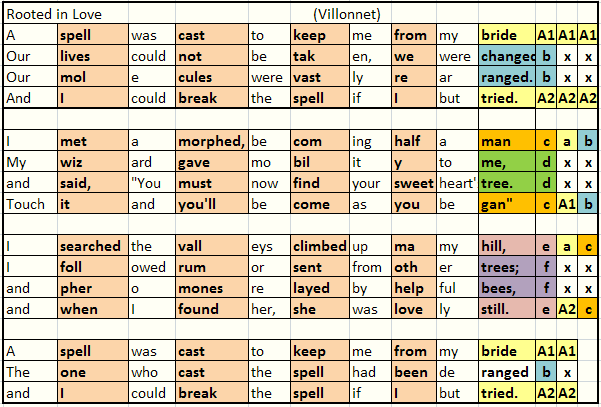
A Villonnet is a hybrid of the Villanelle and the Sonnet. It has the Iambic Pentameter of both, but holds the four-stanza/line structure of the sonnet, while utilizing the two-line rhyme nature of the villanelle. The final stanza replaces the sonnet couplet with a typical villanelle tercet.

The Villonnet is another hybrid form created by D. Allen Jenkins. This is a recent invented form which is said to be a cross between a Villanelle andSonnet.

The Villonet is:
  • a poem in 15 lines, made up of 3 quatrains followed by a tercet.
  • metric, iambic pentameter.
  • rhymed, A¹bbA² cddc effe A¹bA² or A¹xxA² bxxb cxxc A¹xA² x being unrhymed.
  • NOTE: Jenkins also used A1xxA2  axxA1 axxA2

  • L1 is repeated as L13 and L4 is repeated as L15.

Thanks to Judi Van Gorder for the resource at PMO


Example poem

Rooted in Love (Villonnet)

A spell was cast to keep me from my bride 
Our lives could not be taken, we were changed; 
Our molecules were vastly rearranged. 
And I could break the spell if I but tried. 

I metamorphed, becoming half a man 
My wizard gave mobility to me, 
and said, "You must now find your sweetheart's tree. 
Touch it and you'll become as you began" 

I searched the valleys- climbed up many hill, 
I followed rumors sent from other trees; 
and pheromones relayed by helpful bees, 
and when I found her, she was lovely still. 

A spell was cast to keep me from my bride 
The one who cast the spell had been deranged
and I could break the spell if I but tried. 

© Lawrencealot - Oct. 20, 2013


Visual Template

Slide Ballad

This form was invented by Larry Eberhart, aka, Lawrencealot and dedicated to Victoria Sutton, aka, Passionspromise, inventor of the Slide Sonnet.
Slide Ballad consists of six or more quatrains in common meter
Rhyme pattern
(ax)axa (bx)bxb (cx)cxc (ax)axa (dx)dxd (ax)axa
Where (ax) indicates that end-line is unrhymed, but that there is interleaved rhyme from the first section of the first line to end following end-rhyme.

(There need not be multiple stanzas with the same rhyme, but there may be)

Where the a-lines in the final stanza are made up of segments from the preceding a-lines, see template and example.
Feminine rhyme is permitted as exception to common meter.

Example Poem

Soldier   (Slide Ballad)

There was no way he'd fail to join
the fight, and stay and play
while others wore the uniform
and gave their lives away.

His parents' view, was fearful but,
all hoped he'd make it through.
His Margie said "You'll come back, Joe,"
I'll wait until you do.

The war ground on, relentlessly,
'til many friends were gone.
Some missing limbs went home.  Some stayed,
interred 'neath foreign lawn.

Joe suffered grave injuries twice,
from those who would enslave.
He returned to fight each time - saying,
"It's not because I'm brave.

I want to stay until we win,
We shall ,I hope and pray.
I cannot set aside my role
while evil still holds sway.

He was the last left living now
behind the lines when fast
advancing  enemy took charge,
and then the battle passed.

'Twas only he the farmer found
a live, but bound to be
a corpse if left. The farmer cared
with quiet dignity.

Another year elapsed; he healed,
and hid and helped them clear
their crops,  He learned some French and learned
the end of war was near.

There was no way to thank his friends
who'd risked their lives that way.
I'll fetch my Marge, then we'll return;
We shall ,I hope and pray.

  © Lawrencealot - January 8, 2013


Visual Template


Skeltonic Verse

My Summary:  Skeltonic Verse  is:

Any number of lines without a Stanza break
Each line consist of two heavy stresses and any number of unstressed syllable
Lines are mono-rhymed until the poet decides to begin a new rhyme.
The poem should have energy and be fun.

Skeltonic Verse is named after its creator, English poet John Skelton (1460-1529),who tutored King Henry the Eighth when he was just a prince, spent time in prison, was censured by the Church and in general, seemed to have a great amount of fun.

Sources I found useful with more information you may appreciate.

Skeltonic Verse which today is sometimes also referred to as Tumbling Verse, is from the 15th century when English poet John Skelton (1460-1529) created short lines which resemble the hemistich of the Tumbling Verse of King James. It is a subgenre of Georgic, didactic verse, the verse usually being instructional in nature. The lines are of irregular dipodic meter with a tumbling rhyme
Skeltonic Verse is:
  • written in any number of dipodic lines without stanza break.
  • dipodic which is a line with 2 heavy stresses and any number of unstressed syllables.
  • rhymed, tumbling rhyme is any number of monorhymed lines until the rhyme runs out of energy then the lines switch to a new mono-rhyme series. 

My thanks to Judi Van Gorder for the great PMO resource.


Skeltonics
Type:
Structure, Metrical Requirement, Rhyme Scheme Requirement
Description:
Developed by John Skelton (Happy Hank, the Wife Slayer’s poetic mentor and court poet), these are satirical rhymed dipodic lines. It is also known as Tumbling Verse. This requires explaining the difference between podic and accentual-syllabic verse. With accentual-syllabic verse, every syllable counts, both stressed and unstressed. If a line of verse is iambic pentameter, it will be ten syllables alternating between unstressed and stressed as: da_DUM da_DUM da_DUM da_DUM da_DUM.
“I dived beneath the desk to hide from her.”
Podic verse was kind of a looser midway point between the alliterative accentuals of the Anglo-Saxons and the accentual-syllabics that Chaucer adapted into English based on French forms that were rhymed and syllabic. So, podic verse is usually rhymed and has a certain number of stresses in the line, but the number of unstressed syllables doesn’t count. A dipodic line has two stresses. It might have from zero to four unstressed syllables, so the line can vary from two to six syllables and still be dipodic.
“Her eyes aflame
fire bright
cast her claim
all night.”
Although this quatrain varies between two and four syllables per line, they are all dipodic.
Skelton’s rhyming was also inconsistent. He might rhyme two lines in a row or ten, then he’d change rhymes for another indeterminate length, and then do it again.

My thanks to Charles L.  Weatherford who frequently provides more detail and insight than most.


My Example Poem

Dipodic What?

Dipodic Verse
Will be Terse.
Stress used just twice
to keep it nice,
short or long
a lilting song
or sounding gong
that won't go wrong
if you adhere
to the rule here,
Now is that clear
My dear?


© Lawrencealot - 2013

SIJO

SIJO  (from Shadow Poetry Handbook)
A short Korean poetry form consisting of three lines,
each line having a total of 14-16 syllables in four groups 
ranging from 2 to 7 (but usually 3 or 4) syllables, with a natural pause at the end of the second group and a major pause after the fourth group. 

The third line often introduces a resolution, a touch of humor, or a turn of thought. 

Nature is often the subject matter of these poems like traditional haiku."

Either narrative or thematic, 
this lyric verse introduces a truth (perhaps a problem) in line 1, 
development (called a turn) in line 2, 
and a strong conclusion beginning with a surprise (a twist) in line 3, 
which resolves tensions or questions raised by the other lines 
and provides a memorable ending. 


Related Forms: Alphabet Haiku,  Crystalline,  Haibun,  Haiga,  Haiku Haikuette,  KimoLune, PixikuRhaikuSijoUkiahZip


Example Poem


Surprise Test


Trained by nature over time, learned and changed my DNA. 
Teacher springs surprise exam; tough, could be season ending. 
Snow bonnet fends off freezing adds resilience to my beauty. 

 © July 23, 2012


Visual Template